
























IN THIS ARTICLE
- The three Keychron 60% keyboards side by side
- What a 60% keyboard keeps, and where the other keys go
- How to choose a 60% keyboard
- Keychron Q4: Best for an all-metal wired 60%
- Keychron V4 Max: Best for a wireless 60%
- Keychron Carbon 60 HE 8K: Best for 8K magnetic gaming
- Which one is the best 60% keyboard for you
- Frequently asked questions
A 60% keyboard is about as long as a sheet of A4 paper. It keeps the letters, the number row, and the modifiers. On boards like the Q4, the function row, the arrows, and Delete move onto an Fn layer. That trade gives your mouse more room and costs you a second key for some presses. Below are three Keychron picks: a wired aluminum board, a wireless board with a battery, and a wired magnetic board for games.
The short version
- Wired desk, metal body, typing first: the Keychron Q4. CNC-machined aluminum, 1000 Hz over the cable.
- Wireless, more than one device: the Keychron V4 Max. 2.4 GHz, Bluetooth or cable, and a battery rated up to 190 hours with the backlight off (lab test).
- Competitive games on a wired desk: the Keychron Carbon 60 HE 8K. Magnetic switches with an actuation point you set from 0.1 to 3.5 mm, and 8000 Hz over the cable.
- If you remember one thing: decide first whether you can live with arrows on a layer. If not, a 75% keyboard keeps them as real keys.
The three Keychron 60% keyboards side by side
| Best for | Model | Connection | Polling rate | Switch options | Length x width | Weight |
|---|---|---|---|---|---|---|
| Wired metal desk | Q4 | USB-C cable | 1000 Hz | Gateron G Pro Red, Blue or Brown (mechanical) | 303 x 121 mm | 1500 g ± 10 g (Fully Assembled Version) |
| Wireless, several devices | V4 Max | 2.4 GHz, Bluetooth 5.1, USB-C cable | 1000 Hz (2.4 GHz and cable), 90 Hz (Bluetooth) | Gateron Jupiter Red, Brown or Banana (mechanical) | 305 x 123.1 mm | 645 ± 10 g (Fully Assembled Version) |
| Wired 8K gaming | Carbon 60 HE 8K | USB-C cable only | 8000 Hz (wired) | Keychron Ultra-Fast Lime Magnetic Switch | 291.18 x 107.68 mm | 740 g ± 3 g |
The spec sheet says 303 mm for the Q4, 305 mm for the V4 Max, and 291.18 mm for the Carbon 60 HE 8K. On your desk, it means a board close to the long side of an A4 sheet (297 mm). Measure the free width where the keyboard will sit, leaving the mouse its usual spot: about 30.3 cm for the Q4, 30.5 cm for the V4 Max, and 29.1 cm for the Carbon 60 HE 8K.
All three remap in Keychron Launcher, a web app that runs in the browser.
What a 60% keyboard keeps, and where the other keys go
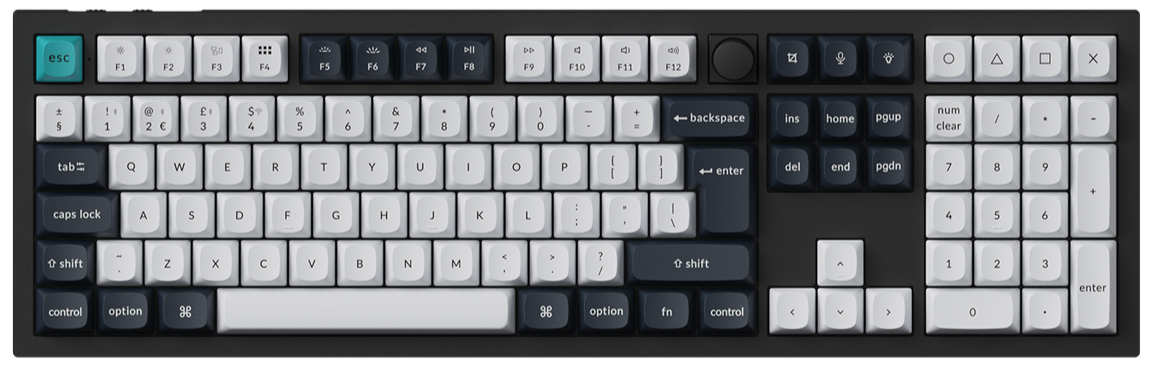
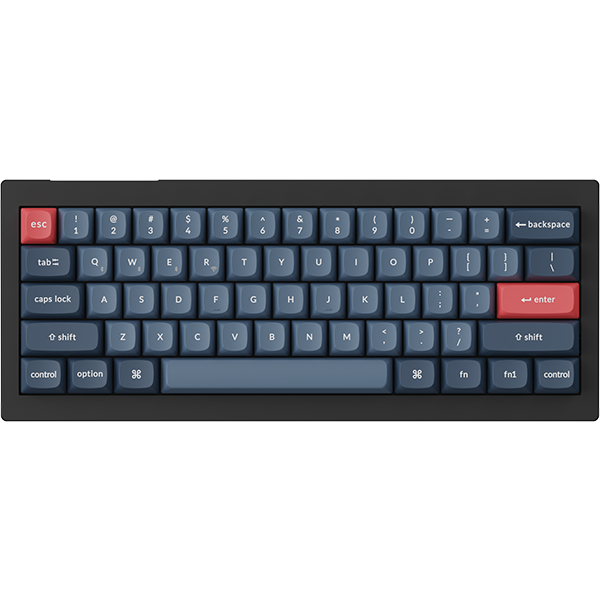
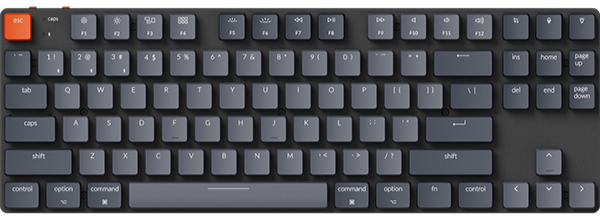
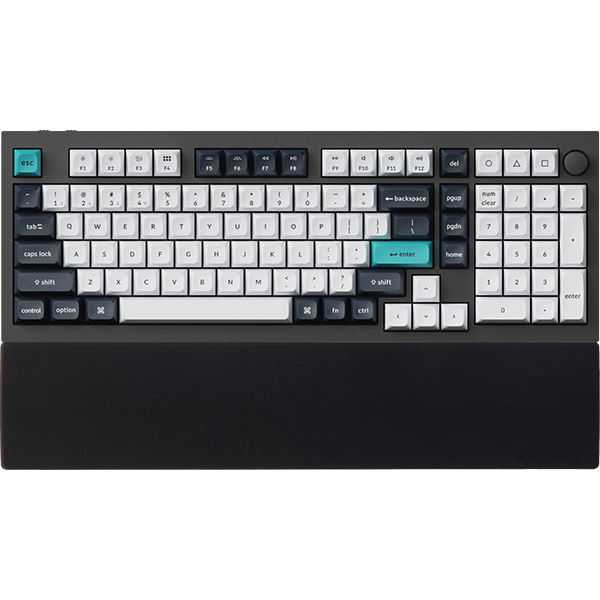
60% means the board keeps roughly 60% of a full-size layout's keys. On the Q4 and V4 Max, that is 61 keys in five rows: the number row, the letters, Tab, Caps Lock, both Shift keys, Enter, Backspace, and the bottom row of modifiers. The function row, Insert, Delete, Home, End, Page Up, Page Down, the arrow keys, and the number pad have no keys of their own.

An illustration of a generic ANSI layout, not a product drawing. The Q4 combinations shown are its default layers; layer positions differ by board.
Most of the missing keys come back on an Fn layer. Hold Fn and some keys change job. Take the Q4: fn1 plus 1 through fn1 plus the equals key gives F1 to F12; fn + ] is Home and fn + ? is Delete; the arrows, End, Page Up and Page Down sit on the same layer. The full list is in the Q4 key combinations table, and you can set your own combinations on each layer in Launcher.
How to choose a 60% keyboard
Layout fit first. If you move through documents with the arrows, Home and End all day, every one of those moves becomes Fn plus a key. If that sounds slow, a 75% keyboard keeps the arrows and function row in a slightly longer body. If you play with a low mouse sensitivity and sweep the mouse wide, the 60% board gives that hand more room.
Then the connection. The Q4 and the Carbon 60 HE 8K are wired only, so there is no battery to charge. The V4 Max adds a 2.4 GHz receiver and Bluetooth 5.1, which pairs with up to three devices. It reports at 1000 Hz over the receiver or the cable and at 90 Hz over Bluetooth, so use the receiver or the cable for games.
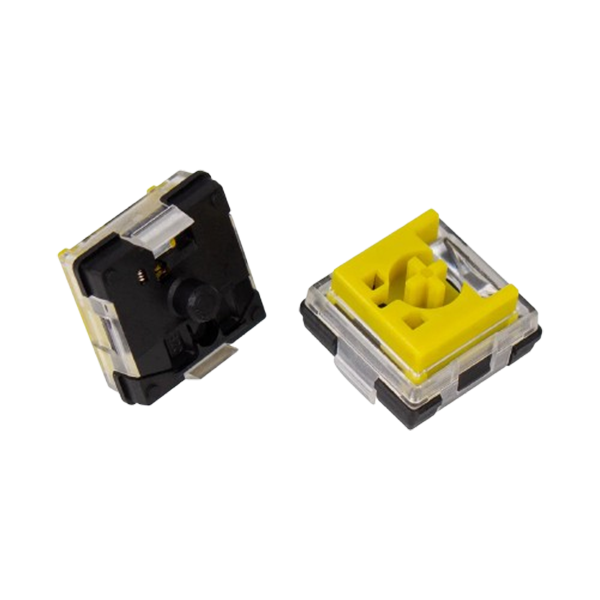
Then the switch. The Q4 and V4 Max use mechanical switches in hot-swap sockets for 3-pin and 5-pin MX switches (most of them, on the V4 Max). The Carbon 60 HE 8K uses a magnetic switch, where you set the depth at which a press counts, and it is hot-swappable with Keychron's Ultra-Fast Lime magnetic switches. Our explainer on magnetic switches covers how the sensor reads a press.
Rule of thumb: layout decides whether a 60% suits you, connection decides the model, switch decides the feel.
Keychron Q4: Best for an all-metal wired 60%

The Keychron Q4 is the metal pick. The body is 6063 aluminum, CNC-machined, with a steel plate and a double-gasket design: silicone pads between the top and bottom cases reduce the acoustic resonance between the metals. It weighs 1500 g ± 10 g as the Fully Assembled Version, more than twice the V4 Max. It connects by USB-C cable at 1000 Hz, runs QMK firmware, and has a system toggle; the Fully Assembled Version includes keycaps for both Mac and Windows.
Pick Fully Assembled in Shell White with Gateron G Pro Red. Gateron G Pro Brown and Gateron G Pro Blue are the other two switches, and the switches come pre-lubricated from the factory. For a dark board, pick Carbon Black - B; the A and B colours differ in their keycap colourway. The hot-swap sockets let you change switches later without soldering.
Keychron V4 Max: Best for a wireless 60%
View the V4 Max on keychron.com →

The Keychron V4 Max takes the same 61-key layout as the Q4 off the cable. It pairs with three devices over Bluetooth 5.1 and runs at 1000 Hz over 2.4 GHz or the cable. USB-C and USB-A receivers come in the box and store in a magnetic slot at the top right corner. The 4000 mAh battery is rated up to 190 hours with the backlight off (lab test) and up to 100 hours with RGB at the lowest brightness. The case is ABS plastic on a gasket mount with a PC plate and sound-absorbing foam, at 645 ± 10 g as the Fully Assembled Version.
Pick Fully Assembled in Carbon Black with Gateron Jupiter Banana. Banana has an early tactile bump at the top of the press. Gateron Jupiter Red and Gateron Jupiter Brown are the other two options on the page. Launcher opens in Chrome, Opera or Edge with the cable plugged in, and the board works with Windows, macOS and Linux.
Keychron Carbon 60 HE 8K: Best for 8K magnetic gaming
View the Carbon 60 HE 8K on keychron.com →

The Keychron Carbon 60 HE 8K is the magnetic pick. You set the actuation point of every switch from 0.1 to 3.5 mm, and Launcher tunes the actuation point and Rapid Trigger sensitivity with precision down to 0.005 mm. With Rapid Trigger on, a key resets after a release distance you set instead of at one fixed point. It supports 8000, 4000, and 1000 Hz over its USB-C cable and has no wireless mode. Last Key Priority and Snap Click are off by default and switch on in Launcher; the HE Mode guide walks through the per-key settings.
Pick Carbon Fibers with Keychron Ultra-Fast Lime Magnetic Switch, the one version on the page. The shell is a carbon fiber composite with about 60% carbon content and over 10× the flexural rigidity of ordinary plastic. The plate is carbon fiber too, and the Cherry-profile carbon fiber composite keycaps carry their legends on the front-facing edges. It weighs 740 g ± 3 g, and Fn + Caps Lock switches between Mac and Windows modes.
Which one is the best 60% keyboard for you
Get the Q4 if the keyboard stays wired on one desk and you want a metal body and mechanical switches you can swap.
Get the V4 Max if you switch between a computer, a tablet, and a phone, or want a board without a cable.
Choose the Carbon 60 HE 8K if you play competitive games on a wired desk and want to set the actuation depth per key.
Still unsure about the size? Our Keyboard Finder filters by layout, connection, and material, and the best Keychron keyboard guide covers the larger layouts.
Frequently asked questions
Is a 60% keyboard good for gaming?
If your games use WASD and the keys around it, everything you press is still on the board, and the mouse gets more room. For adjustable actuation and 8000 Hz over the cable, pick the Carbon 60 HE 8K. Our 8K polling rate post shows how to set 8000 Hz.
Does a 60% keyboard have arrow keys?
Not as separate keys. The Q4 puts the arrows on the Fn layer with Home, End, Page Up, Page Down, and Delete, and you can move them to other keys in Keychron Launcher. If you want dedicated arrows, a 75% keyboard keeps them.
Is a 60% keyboard good for programming or office work?
It works well if you mostly type text and use shortcuts with Ctrl or Command. If you jump around code or spreadsheets with Home, End, and the Page keys, each of those is an Fn press on a 60% board. In that case, look at a 75% layout, or remap the layer so those keys sit under your right hand.
Shop the gear


References & Citations
- Q4 layout, aluminum body, double-gasket design, steel plate, 1000 Hz wired, Gateron G Pro switches, hot-swap, size, weight and selector options. (Keychron Q4 product page)
- V4 Max connections, polling rates, receivers, battery ratings, gasket mount and PC plate, Gateron Jupiter switches, size, weight and selector options. (Keychron V4 Max product page)
- Carbon 60 HE 8K carbon fiber build, actuation range, 0.005 mm precision, 8000 Hz wired polling, LKP and Snap Click defaults, size and weight. (Keychron Carbon 60 HE 8K product page)
- The Q4 default fn and fn1 layers: F1 to F12, Home, End, Page Up, Page Down, Delete and the arrows. (Q4 key combinations)
- How actuation distance and Rapid Trigger are set per key in Keychron Launcher. (How to use HE mode on Keychron Launcher)
- How a magnetic switch reads a press without metal contacts. (What are Hall Effect switches and how do they work)
- How to switch a Keychron 8K keyboard to 8000 Hz polling. (Boost your performance with 8K polling rate)